Stillness as Strategy: How the Japanese Art of Purposeful Waiting Is Reshaping American Ambition
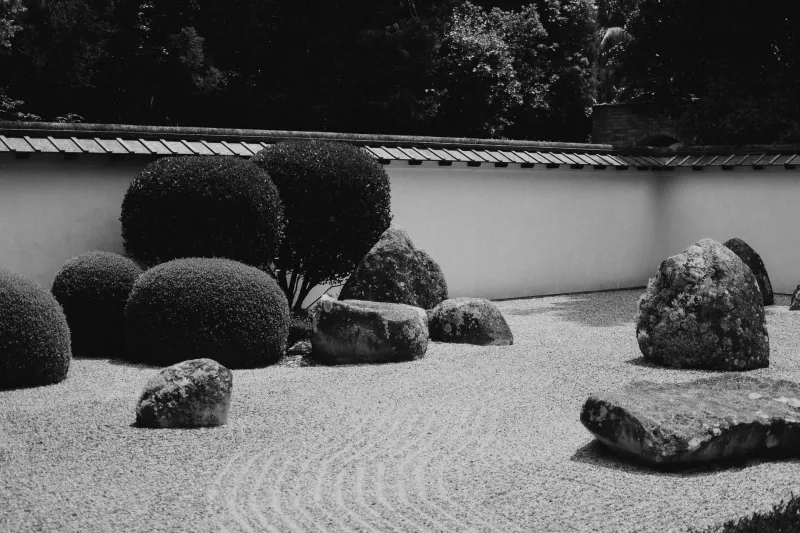
There is a particular kind of confidence that does not announce itself. It does not refresh its inbox every four minutes, does not pivot on impulse, and does not confuse velocity with progress. It waits. And in that waiting, it accumulates something that no productivity system can manufacture: clarity.
This is the quiet teaching at the heart of matsu — a Japanese concept that translates, inadequately, as "to wait," but carries within it an entire philosophy of deliberate restraint. In Japan, matsu is woven into the fabric of daily life, from the unhurried cultivation of a bonsai tree to the years-long apprenticeship of a sushi master who will not touch fish until his rice is deemed worthy. It is not patience in the Western sense — stoic endurance of delay — but something more active: a purposeful, attentive stillness that sharpens perception and deepens judgment.
For a certain cohort of American professionals, this distinction is proving transformative.
The Hustle Hangover
The American professional class spent the better part of two decades worshipping at the altar of acceleration. Side hustles, growth hacking, the "always-on" executive — these were not merely behaviors but badges of identity. To be busy was to be valuable. To pause was to fall behind.
The cultural reckoning, when it came, arrived quietly. Burnout statistics climbed. Executive turnover accelerated. Entrepreneurs who had built companies at breakneck speed found themselves presiding over organizations that were structurally fragile, culturally hollow, or simply exhausting to lead. The machinery of hustle had delivered results, but at a cost that balance sheets could not fully capture.
It is into this moment of collective fatigue that matsu has arrived — not as a wellness trend or a retreat offering, but as a genuine recalibration of what sophisticated ambition looks like.
What Purposeful Waiting Actually Looks Like
To understand matsu as practice rather than concept, consider the experience of a Manhattan-based venture capital partner who, several years ago, began incorporating extended deliberation periods into her investment process. Where her firm's culture had previously rewarded swift conviction — the ability to say yes or no within forty-eight hours of a pitch — she instituted what she privately called a "fallow period" before any commitment above a certain threshold.
The results, she has noted in industry conversations, were not slower decisions but better ones. The waiting was not idle. It involved quiet observation: tracking a founder's behavior under pressure, watching how a market shifted over a single quarter, allowing her own initial enthusiasm or hesitation to settle into something more reliable. The matsu she practiced was not delay — it was discernment in motion.
This distinction matters enormously. Matsu is not an excuse for indecision. In Japanese craft traditions, the waiting master is never disengaged. The ceramicist who waits for a glaze to cure is simultaneously studying the kiln's behavior, refining her understanding of the material, preparing for the next step with complete attention. The waiting is part of the work.
The Dressed Mind: Patience as an Aesthetic Sensibility
What makes matsu particularly resonant for the タイタイ reader is the way it extends beyond professional strategy into the realm of personal style and self-presentation — domains where American culture has also suffered from an excess of speed.
The rise of fast fashion, the algorithmic churn of trend cycles, the pressure to be perpetually current: these are the aesthetic equivalents of hustle culture, and they produce the same results. Wardrobes that are simultaneously overfull and inadequate. A relationship with clothing that is acquisitive rather than considered. Style that is reactive rather than expressed.
Japanese fashion philosophy — particularly the sensibility cultivated in Kyoto's more traditional circles and echoed in the quiet precision of designers such as Yohji Yamamoto and Issey Miyake — operates from an entirely different premise. Quality is accumulated slowly. Pieces are chosen not for their novelty but for their capacity to deepen over time. The well-dressed person in this tradition is not someone who has more, but someone who has waited longer, looked harder, and chosen with greater care.
American tastemakers are beginning to internalize this. Personal stylists working with high-net-worth clients report a marked shift in recent seasons: fewer requests for comprehensive wardrobe overhauls, more interest in identifying two or three foundational pieces of genuine distinction. The question is no longer "What is new?" but "What is worth waiting for?"
Relearning the Value of Ripening
Japan has a cultural vocabulary for the kind of excellence that cannot be rushed. Shokunin — the artisan spirit — implies decades of refinement. Shibui — a quality of austere beauty — cannot be manufactured; it must be arrived at through time and restraint. Even the Japanese aesthetic of wabi-sabi, which Western audiences often reduce to a love of imperfection, is more precisely an appreciation for the beauty that emerges only after things have been allowed to age, to weather, to become fully themselves.
These concepts share a common root: the belief that the most enduring forms of excellence are not achieved but ripened. And ripening, by definition, cannot be accelerated without loss.
For American professionals accustomed to measuring progress in quarterly increments, this represents a genuine philosophical shift. It asks not merely for patience as a tactic, but for a revised relationship with time itself — one in which the interval between intention and outcome is not wasted space but an essential part of the process.
Practicing Matsu in an Accelerated World
Adopting this philosophy does not require a sabbatical in Kyoto, though that would not be unwelcome. It begins with smaller recalibrations: introducing a structured pause before major decisions, resisting the reflex to respond immediately to every communication, allowing creative projects to rest between drafts rather than forcing them toward premature completion.
It also means developing a more refined tolerance for ambiguity — the willingness to hold a question open rather than forcing a resolution that satisfies the ego but forecloses better possibilities. In Japanese aesthetics, this quality is sometimes called ma, the productive emptiness between things. In professional life, it manifests as the capacity to sit with uncertainty without collapsing it prematurely into false certainty.
The executives and creatives who have integrated matsu into their practice describe a common outcome: not slower results, but more durable ones. Decisions that hold. Relationships that deepen. Work that bears revisiting rather than demanding constant replacement.
The New Measure of Mastery
American ambition is not disappearing. It is, perhaps, growing up. The most compelling professionals of the next decade will not be those who moved fastest, but those who moved most deliberately — who understood that the quality of an outcome is inseparable from the quality of the attention brought to its unfolding.
Matsu offers a framework for that attention. It asks us to reconsider what we are actually waiting for when we wait — and to recognize that in the right hands, stillness is not the opposite of ambition. It is its most refined expression.