The Space Between: Why America's Most Design-Forward Homes Are Embracing the Japanese Philosophy of Ma
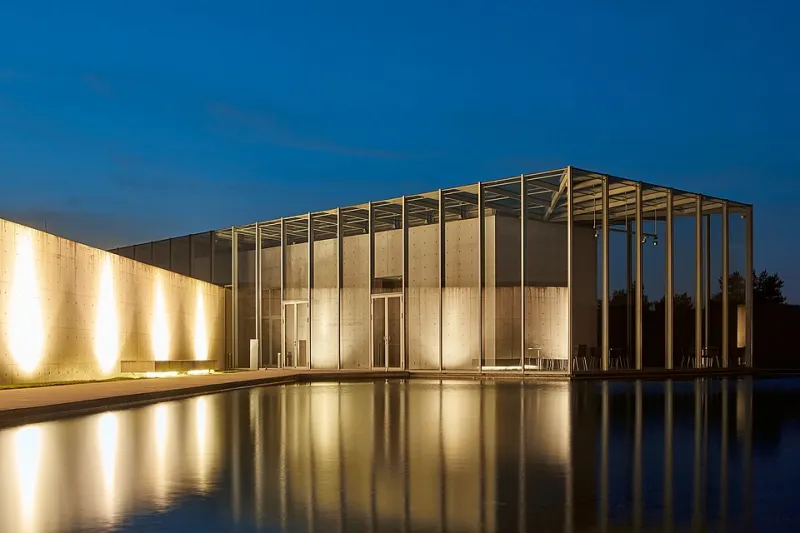
Photo: Anıl Öztaş, CC BY-SA 4.0, via Wikimedia Commons
There is a particular kind of silence that greets you when you step into a well-designed room — not the silence of absence, but of intention. Every object earns its place. Every surface breathes. This is the experience that an increasing number of affluent American homeowners are seeking, and it has a name borrowed from Japanese aesthetics: ma (間).
Translated loosely as "negative space" or "the pause between," ma is far more than a design trend. It is a philosophy rooted in the Zen Buddhist tradition, one that treats emptiness not as a void to be filled, but as an active, living element of composition. And in an era of relentless accumulation, its appeal to the American luxury market feels almost inevitable.
What Ma Actually Means — And What It Doesn't
Before we discuss its application in American homes, it is worth clarifying what ma is not. It is not minimalism in the Scandinavian sense — cool, clinical, and stripped of warmth. Nor is it the stark emptiness of a gallery space. Ma is relational. It is the deliberate distance between a single ceramic vase and the wall behind it, the unhurried expanse of a tatami room, the way a garden stone seems more significant because of the raked gravel surrounding it.
"Ma is about creating a conversation between objects and the space they inhabit," explains Kenji Mori, a Japanese-American interior architect whose studio, based in SoHo, has completed projects for clients ranging from tech executives in San Francisco to art collectors in Miami. "When I work with American clients, the first thing I ask them to do is remove something they love from a room. Not permanently — just temporarily. The reaction to that absence tells me everything about how they relate to their space."
This relational quality is precisely what distinguishes ma-informed design from mere decluttering. Marie Kondo may have introduced Americans to the act of letting go, but ma asks a deeper question: once the unnecessary is removed, what does the remaining space say?
The Transformation of an Upper East Side Townhouse
For Catherine and David Hartley, a finance attorney and a museum curator respectively, the answer to that question took eighteen months and a complete reconception of their five-story Manhattan townhouse to discover.
"We had beautiful things," Catherine recalls, seated in a living room that now contains, by design, a single low sofa, a lacquered side table, and a scroll painting by a contemporary Japanese artist. "But we had too many beautiful things. They were competing with each other. Nothing had room to be itself."
Their designer, Los Angeles-based Naomi Takahashi of Studio Haku, guided the couple through a process she describes as "spatial editing" — a term she prefers to renovation. "Renovation implies construction," she explains. "What we did was closer to curation. We asked: what is the single most important thing in this room? And then we built the space around that thing's need to be seen."
The results are striking. The home's former dining room, once crowded with a twelve-seat table, a sideboard, and a gallery wall of framed prints, now holds an eight-seat table of unfinished white oak, two branches of dried cherry blossom in a tall floor vase, and nothing else. The walls are the color of unbleached linen. The effect is not sparse — it is, paradoxically, deeply abundant.
Practical Principles for the Ma-Curious American Home
For those who wish to introduce this philosophy into their own spaces without undertaking a full renovation, Takahashi offers several entry points:
Begin with one room, not the whole house. Ma is most powerfully felt when it exists in contrast. Choose a single room — ideally one used for rest or reflection — and commit to applying the principle there first.
Audit by relationship, not by category. Rather than sorting objects into "keep" and "discard" piles, ask how each object relates to its neighbors. If two objects are not actively enhancing each other's presence, one may need to find a new home.
Invest in fewer, slower surfaces. American interiors tend toward layering — rugs upon rugs, cushions upon cushions. Ma-informed design favors materials that reveal their character slowly: raw stone, aged wood, handmade ceramics. These surfaces do not need ornamentation. They are the ornament.
Honor the floor. Japanese interior traditions treat the floor as a plane of significance, not simply a surface to cover. Leaving portions of a beautiful hardwood or stone floor uncovered is not an oversight — it is a statement.
Resist the impulse to fill. This is, for many American clients, the most difficult instruction to follow. "There is a cultural anxiety around empty space," Mori observes. "People feel they have to explain it, justify it. But ma teaches us that empty space is not a problem to be solved. It is a gift you give the room — and yourself."
The Luxury of Less
It is worth noting that ma, in its most refined expressions, is not an inexpensive philosophy to practice. The objects that survive the editing process must be exceptional — because they will be seen, fully and without competition. This is driving significant interest among American luxury consumers in Japanese craft traditions: Bizen pottery, Kyoto textile arts, hand-forged ironwork from Iwate Prefecture.
Auction houses and specialty importers have taken notice. Several New York galleries now dedicate entire seasons to Japanese craft objects specifically marketed to the interior design trade. The price points reflect the philosophy: a single Bizen tea bowl may carry a four-figure price tag, but in a ma-informed room, it is the room's defining object. The calculus, as Takahashi frames it, is straightforward. "You are not buying one expensive thing instead of ten cheap things. You are buying the experience of truly living with something beautiful."
In a cultural moment defined by algorithmic abundance — infinite scroll, next-day delivery, the endless accumulation of the merely adequate — the Japanese art of ma offers something genuinely countercultural: the radical proposition that the space around a thing is as valuable as the thing itself.
For a growing community of American homeowners, that proposition is not a sacrifice. It is, at last, the point.